
How to remove suncream and lotion stains
Updated · By the Luniva team
Quick answer
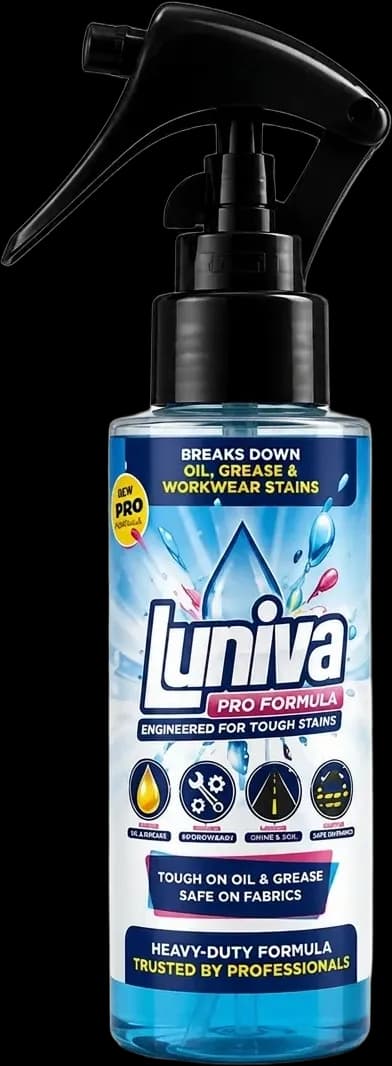
Use Luniva Pro Formula (the blue one). Spray it directly onto the stain, leave it for 1–3 minutes, then wash as normal following the garment care label.
Treat suncream the same day if you can, and air-dry until the mark has fully gone.
Step by step
- 1
Spray directly
Spray Luniva Pro Formula onto the stain until it's covered. Ready to use: never add water. Use in a well-ventilated area.
- 2
Wait 1–3 minutes
Leave it to work. Don't let it dry on the fabric.
- 3
Wash as normal
Wash with your usual detergent, following the garment care label. Check the stain has gone before tumble drying, as heat can set any residue.
Safe handling for Pro Formula
- Use in a well-ventilated area. Open a window or run an extractor fan.
- Keep away from open flames, sparks and hot surfaces while spraying.
- Avoid spraying towards the face or eyes. Wear household gloves for prolonged use.
- Keep out of reach of children. Wash hands after handling.
Suncream leaves persistent yellow or orange oily marks on shirts, swimwear, towels and beach cover-ups, and moisturiser, hand cream and baby oil leave similar greasy marks. Luniva Pro Formula is made for suncream and lotions: spray, wait 1–3 minutes, then wash as normal.
Why suncream leaves yellow and orange marks
SPF products combine oil-soluble UV filters with silicones and waxes designed to cling to skin and resist water. The UV filter avobenzone reacts with iron and other minerals in tap water to form a rust-coloured mark that gets darker the longer it sits. Pro Formula is not an enzyme product. It uses grease-releasing chemistry and surfactants to loosen oily deposits from washable fabric fibres so they can be carried away in the wash.
Fabric guide
Recommended
Cotton, polyester, polycotton, denim, canvas, heavy workwear and most colour-fast everyday garments, towels and bedding.
Avoid
Silk, wool, leather, suede, rayon/viscose, acetate, delicate synthetics, waterproof membranes (e.g. Gore-Tex), flame-retardant finishes, and anything whose care label warns against solvents.
Patch-test first
Spray a hidden area such as an inside seam, leave 1–3 minutes, rinse and let it dry. If you see colour loss, stiffness or surface change, don't use it on that garment.
Use it on its own
Ready to use: never add water. Never mix with bleach, ammonia, acidic cleaners or other detergents. Don't let it dry on the fabric.
Suncream & lotions: questions
Avobenzone, the UV filter in most SPF products, reacts with iron and other minerals in tap water to form a rust-coloured mark. Heat from a hot wash or dryer locks it in.
Yes. For older or set-in marks, apply twice if needed. Check before drying and never tumble dry until the mark is fully gone.
Yes: SPF marks on towels and swimwear are among the stains Pro Formula is made for. Patch-test a hidden seam first, and avoid waterproof membranes and delicate synthetics.
The blue one. Luniva's product guidance is to use Pro Formula for greasy and oily marks such as suncream, makeup and body oils.
Based on controlled laboratory testing. Performance may vary by stain type, fabric, age of the stain and wash conditions. Always follow the garment care label and test an inconspicuous area first.