How to Remove Urine Stains from Carpets & Mattresses
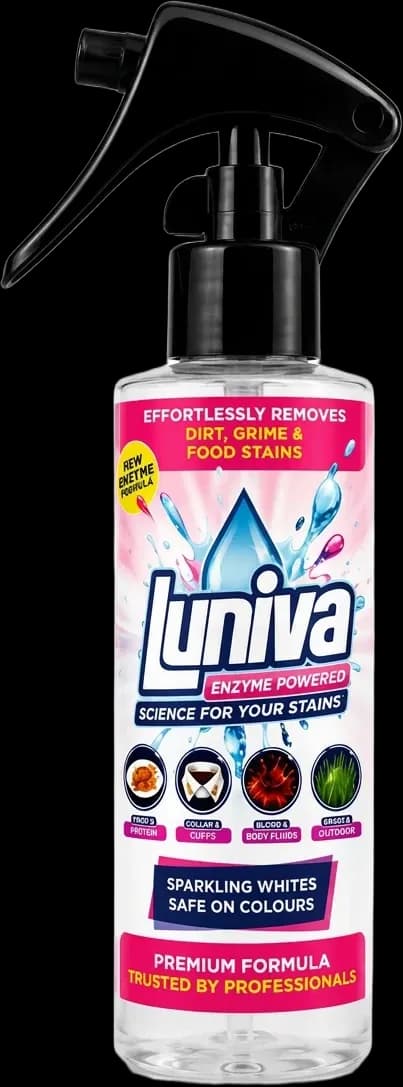
Urine is the one stain where 'looks gone' is not the same as gone. Dog, cat and human urine all carry urea, urochrome and — the part nothing else breaks — uric acid crystals. Rinse with water or oxygen cleaners and the visible mark lifts; the uric acid stays bonded to carpet fibre or mattress ticking and re-releases ammonia every time the room warms up or humidity climbs. That is why a 'cleaned' patch smells again the next morning, and why a dog keeps returning to the same corner of the rug. Luniva's protease + lipase active enzymes digest the protein binders and the uric acid matrix at the molecular level, so the source of the smell is removed instead of masked. The formula is bleach-free, ammonia-free and pet-safe once dry — safe for use on carpets, rugs, mattresses, mattress toppers, sofa cushions, car upholstery and washable bedding. This guide covers fresh accidents on carpet, dried-in urine patches on mattresses, dog pee on rugs and toddler accidents on bedding.
Why oxygen cleaners and vinegar don't stop urine smell
Urine is three problems in one liquid: urea (a salt that rinses out), urochrome (the yellow pigment that stains fibre) and uric acid crystals (the part that smells). Uric acid is insoluble in water and unreactive to vinegar, baking soda and most oxygen-based carpet shampoos — they lift the colour and leave the smell. Worse, ammonia-based cleaners read like a fresh urine signal to a dog or cat and actively reinforce marking behaviour. Only enzymes break uric acid: protease unbinds the protein scaffold, lipase digests the fat that holds the crystals in place, and the surfactant flushes the residue out of the carpet pile or mattress filling. That is how Luniva stops the smell returning instead of covering it for an evening.
How to use Luniva on urine stains & odour
- Step 1 — Blot the wet patch first: Press clean kitchen paper or a microfibre cloth onto the urine until no more liquid lifts. Never scrub — scrubbing drives urine deeper into the carpet underlay or mattress foam.
- Step 2 — Saturate generously with Luniva: Spray Luniva 2–3 cm wider than the visible patch — urine spreads sideways as it soaks in, so the smell zone is larger than the mark. On dried-in stains, soak fully so the enzymes reach the underlay or foam below.
- Step 3 — Wait 10–15 minutes, then blot or wash: Leave the enzymes to digest the proteins and uric acid. On carpet and mattresses, blot dry with a clean cloth and air-dry fully. On washable bedding, machine-wash at 30–40°C and air-dry — never tumble-dry urine-stained fabric until the smell is gone.
Compliance note: Based on controlled laboratory testing. Performance may vary by stain age, fabric type and wash conditions.
Related stain guides
Frequently asked questions
How do I get dog pee out of carpet so the smell doesn't come back?
Blot the wet patch with kitchen paper until no more liquid lifts, then saturate with Luniva 2–3 cm wider than the visible mark. Leave 10–15 minutes so the enzymes can digest the uric acid crystals — the part of urine that re-releases ammonia when the air warms. Blot dry and air-dry. Unlike vinegar, baking soda or oxygen cleaners, Luniva breaks the uric acid, so the smell stops returning instead of being masked.
How do I remove urine stains from a mattress?
Strip the bedding, blot the patch, and spray Luniva generously — enough to soak the top 1–2 cm of foam below the cover. Leave 10–15 minutes, blot with a dry towel, then air-dry with a fan above the mattress for 4–6 hours. Do not soak a memory-foam core through. Once dry, sprinkle bicarbonate of soda and vacuum off to lift any last trace of moisture.
Why does my carpet still smell of urine after I cleaned it?
Because most cleaners only lift urea and urochrome — they leave uric acid crystals behind in the carpet pile and underlay. Uric acid is insoluble in water and unreactive to vinegar or baking soda, but it reactivates whenever humidity rises and re-releases ammonia. You need a protease + lipase enzyme treatment like Luniva that digests the crystals at the molecular level.
Will Luniva remove old, dried-in urine stains?
Yes. Saturate the patch fully so the product reaches the underlay or mattress foam below — old urine usually penetrates well beyond the visible mark. Leave 15 minutes. For very old patches, repeat once and air-dry between applications. Do not steam-clean before treatment; heat sets the protein and makes the smell permanent.
Is Luniva safe to use around dogs, cats and small children?
Yes — Luniva is bleach-free, ammonia-free and pet-safe once dry. Keep pets and small children off the treated area until it is fully air-dried, which is normal for any wet cleaner. The active enzymes break down naturally once they have finished digesting the stain.
Can I use vinegar or baking soda on urine instead?
They help mask surface odour for a few hours but do not break uric acid crystals or the protein binders in urine. Enzymes are the only way to digest the source of the smell rather than cover it. Vinegar can also permanently fix some carpet dyes — spot-test before any use.
How do I stop my dog returning to the same spot on the carpet?
Dogs return to spots that still smell like urine at concentrations you cannot detect. Treat the patch with Luniva, then re-treat it expanding 5 cm wider than the original mark — urine spreads laterally as it soaks in. Once the area is fully air-dried and odour-free to you, the dog usually stops marking it.
Does Luniva work on human urine on a mattress or sofa?
Yes — the chemistry is the same. Saturate the patch, wait 10–15 minutes, blot dry and air-dry fully. For washable covers, machine-wash at 30–40°C with Luniva pre-sprayed on the stain. Do not tumble-dry until the smell is gone.