
How to remove curry and turmeric stains
Updated · By the Luniva team
Quick answer
Use Luniva Enzyme Powered (the pink one). Spray it directly onto the stain, leave it for 1–3 minutes, then wash as normal following the garment care label.
Don't use chlorine bleach on curry: it reacts with turmeric and can turn the stain bright orange. If an oily ring stays after washing, treat it with Pro Formula.
Step by step
- 1
Spray directly
Apply Luniva to the stain until saturated. No rubbing, no pre-soak.
- 2
Wait 1–3 minutes
Active Enzymes break the stain down at the molecular level. Don't let it dry.
- 3
Wash as normal
Machine-wash as normal. Air dry; never tumble dry until you've confirmed the stain is gone.
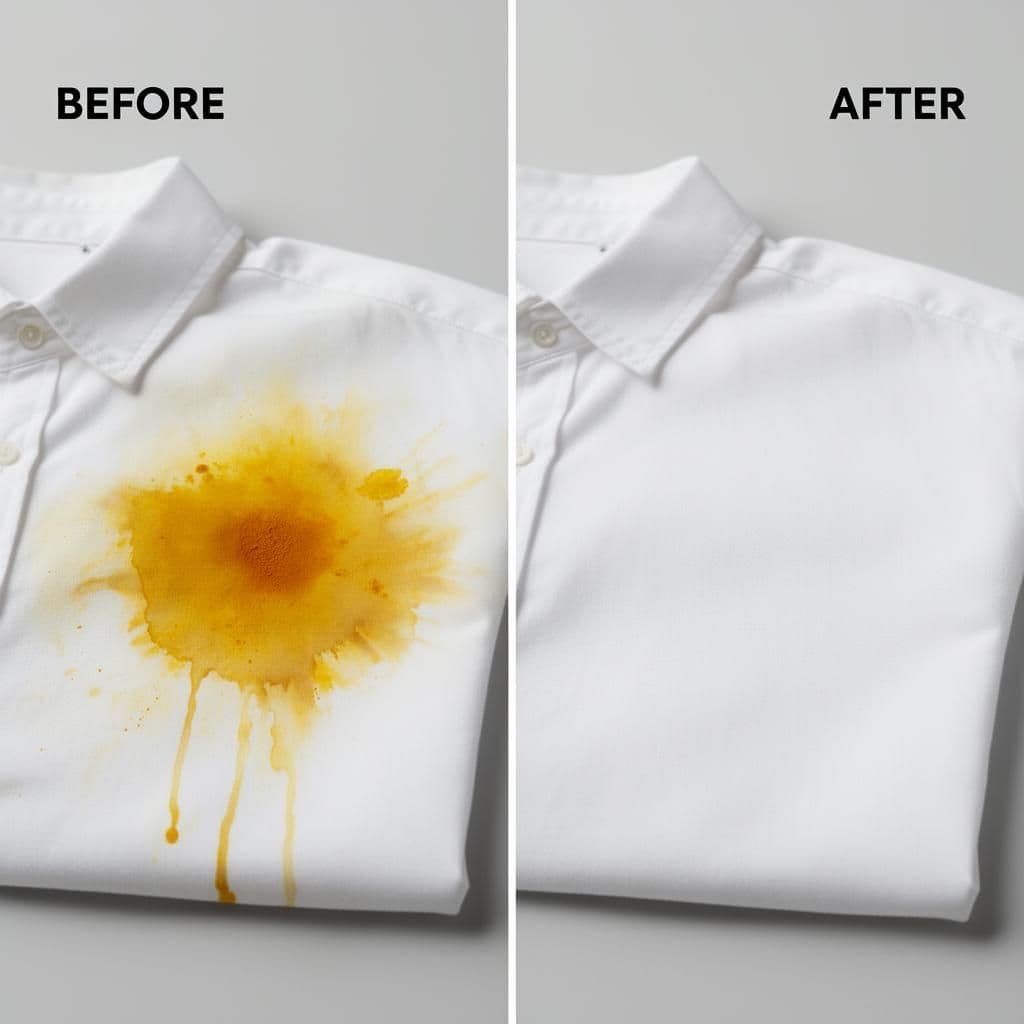
How to remove curry stains from fabric in three steps: spray Luniva on the stain, wait 1–3 minutes, then wash as normal, following the garment care label. Curry and turmeric are among the most stubborn household stains because curcumin is an oil-soluble pigment that bonds tightly to cotton, linen and synthetic fibres – and reacts with sunlight to set permanently. Luniva's active enzyme formula breaks down both the oil base and the yellow pigment without bleach, so the same method works on white shirts, coloured cotton, saris, kurtas, table linen and kids' clothes.
Why curry stains are so hard to remove from fabric
Turmeric (curcumin) is a fat-soluble pigment that bonds to natural fibres like cotton and linen. Heat, sunlight and standard washing only drive the stain deeper, which is why a curry spill on a white shirt often turns into a permanent yellow shadow after one wash + dry cycle. To lift it cleanly you need an active enzyme + surfactant combination that breaks the oil carrier first and then dismantles the pigment molecule – exactly how Luniva's Enzyme Powered formula is engineered.
Fabric guide
Best on washable everyday fabrics
Cotton, linen, denim, polyester and cotton blends: clothes, kidswear, bedding, towels and washable covers.
Test first on delicates
Patch-test an inconspicuous area on silk, wool, viscose, leather-trimmed items or anything labelled dry-clean only.
Don't let it dry
Spray, leave 1–3 minutes, then wash. Don't let the treated area dry out before washing.
Check before drying
Inspect the area after washing and repeat if any shadow remains. Dryer heat can set a leftover mark.
Curry & turmeric: questions
On a white shirt, spray Luniva onto the stain, wait 1–3 minutes, then wash as normal, following the garment care label. Do not use chlorine bleach – it reacts with turmeric and can turn the stain bright orange. If a faint yellow remains, repeat once and dry flat in indirect daylight to let the last of the curcumin break down naturally.
Yes. For dried or already-washed turmeric stains, spray Luniva and let it sit 1–3 minutes before washing as normal, following the garment care label. Fully set stains may need two applications – see our guide on removing set-in stains after drying for the full method.
40°C is optimal. Higher temperatures (60°C+) can heat-set turmeric pigment into the fibre, while cold washes don't activate the enzymes effectively. Always treat with Luniva first, then run a standard 40°C cycle.
Test on a hidden seam first. Luniva is safe on most cotton and synthetic fabrics, but silk, chiffon and zari or gold embroidery should be spot-tested before full application. For pure silk saris, dab – do not spray – and rinse immediately.
Yes. The chemistry is essentially the same across all creamy curry sauces – oil, dairy, tomato and turmeric in varying ratios. The Luniva 1–3 minute protocol works on all of them.
Standard detergent dissolves the protein and starch in the curry, but it cannot break the fat-soluble curcumin pigment. The yellow residue you see after a normal wash is pure turmeric pigment bonded to the fibre. Luniva's lipase + amylase combination releases it so it rinses out cleanly.
Based on controlled laboratory testing. Performance may vary by stain type, fabric, age of the stain and wash conditions. Always follow the garment care label and test an inconspicuous area first.