
How to remove mud and dirt stains
Updated · By the Luniva team
Quick answer
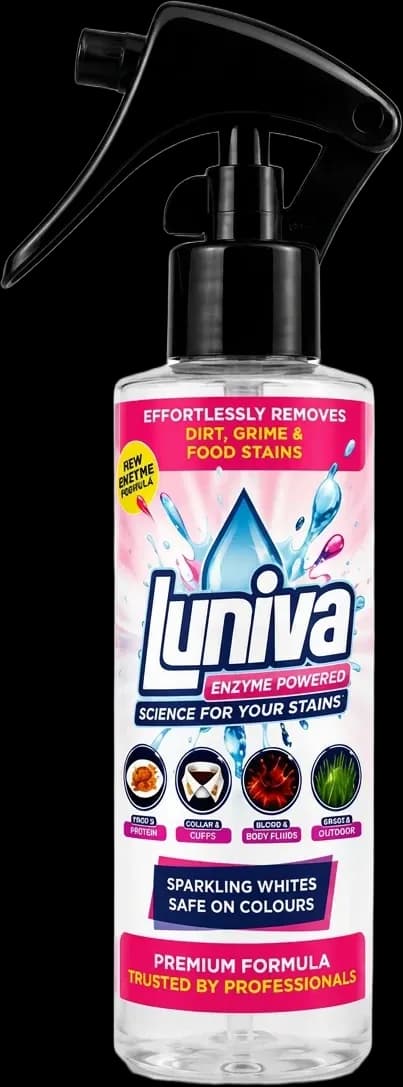
Use Luniva Enzyme Powered (the pink one). Spray it directly onto the stain, leave it for 1–3 minutes, then wash as normal following the garment care label.
Let wet mud dry completely first, then brush off the loose soil before spraying.
Step by step
- 1
Let the mud dry fully
Hang the garment up and wait until the mud is completely dry – do not wash, scrub or rinse it wet. This is the most important step.
- 2
Brush off and spray Luniva
Knock off the dry crust outdoors with a stiff brush or by tapping the garment. Then spray Luniva directly on the remaining brown shadow until saturated. Wait 1–3 minutes.
- 3
Wash as normal
Machine-wash as normal and air-dry. For deep-soaked mud (football boots through trousers), repeat the spray + 1–3 minute wait twice before washing.
Mud looks like one stain but is actually two – the loose surface dirt that brushes off easily, and the brown shadow underneath made of clay, silt and ground-in organic matter that bonds to fabric fibres on contact. The single biggest mistake is treating mud while it's still wet: scrubbing wet mud grinds the particles deeper into the weave and turns a brushable mark into a permanent shadow. The right method is the opposite of instinct: let it dry first. This guide covers football and rugby kit, walking trousers, jeans, school uniform and garden clothes.
Why wet mud is harder to clean than dry mud
Wet mud is suspended particles that flow into every gap in the weave. Rub it, and you grind clay and silt straight into the fibre core. Let it dry, and the same particles harden into a brittle crust on the surface that knocks off cleanly with a stiff brush – leaving only the residual shadow for Luniva to lift. The brown shadow is mostly tannins and plant matter, exactly what Luniva's cellulase and protease enzymes are built to break down.
Fabric guide
Best on washable everyday fabrics
Cotton, linen, denim, polyester and cotton blends: clothes, kidswear, bedding, towels and washable covers.
Test first on delicates
Patch-test an inconspicuous area on silk, wool, viscose, leather-trimmed items or anything labelled dry-clean only.
Don't let it dry
Spray, leave 1–3 minutes, then wash. Don't let the treated area dry out before washing.
Check before drying
Inspect the area after washing and repeat if any shadow remains. Dryer heat can set a leftover mark.
Mud & dirt: questions
No – let them dry first. Wet mud is suspended particles that grind into the weave the moment you rub or wash them. Hang the garment up, wait until the mud is fully dry, then brush off the crust and spray Luniva on the remaining shadow.
Brush off the dry crust outdoors, then soak the muddy area in cold water with Luniva sprayed in for 30 minutes. Spray Luniva again on the brown shadow, wait 1–3 minutes and wash as normal, following the garment care label. For ground-in mud, repeat once.
Yes. Brush off the dry crust, spray Luniva and wait 1–3 minutes, wash as normal, following the garment care label, then air-dry in sunlight. For deeply ground-in mud, repeat the pre-treatment twice – UV light brightens any final shadow.
The shadow is tannins and plant matter from the soil bonded to the fibre – not the loose mud itself. Spray Luniva on the dry shadow, wait 1–3 minutes, wash again as normal, following the garment care label, and air-dry. Most shadows lift on this second pass.
Yes. Bleach-free, colour-safe, fibre-safe on cotton, polyester and most performance blends. Spot-test heat-pressed prints on a hidden area first.
Based on controlled laboratory testing. Performance may vary by stain type, fabric, age of the stain and wash conditions. Always follow the garment care label and test an inconspicuous area first.